
Greenville City Directory Collections
Greenville has several distinct city-directory trails, not one continuous run. The South Carolina Room at Hughes Main Library is the main local discovery and access point. Its catalogue documents Hill volumes from 1931 through 1980 with gaps, R. L. Polk volumes beginning in 1983, and a later Polk series from 1997 onward. The Greenville County Historical Society reports directories beginning in 1883. A digitized 1921–22 volume adds an online starting point, but a researcher should name the exact edition before drawing a conclusion from it.
| Collection | Years | Where held | Access |
|---|---|---|---|
| Greenville County Historical Society directories | From 1883 | Greenville County Historical Society | Physical-repository and appointment context |
| South Carolina Room local directory holdings | 1896–97, 1899–1900, 1909, 1921, and selected Hill years | Hughes Main Library | Catalogue, appointment, staff help, and local materials |
| Hill Directory Co. | 1931, 1933, 1935, 1938, 1940–66 with gaps, 1967–74, 1977, 1980 | South Carolina Room catalogue record | Confirm the particular volume with the room |
| R. L. Polk and later series | 1983–85, 1987, 1989–96; later series from 1997 | South Carolina Room catalogue records | Confirm each volume at the room |
| Greenville, S.C. City and Suburban Directory | 1921–22 | South Carolina Digital Library | Digitized page images and OCR |
Use the catalogue to locate a title, then treat the room, the digital collection, and a staff request as separate channels. A catalogue result says a volume exists. It does not mean the same volume is online, immediately available, or a continuous series.
Greenville City Directory Years on the Shelf
The Hill title describes itself as a directory of householders, office-building occupants, and other business places, with a complete street and avenue guide. Its documented gaps matter. Do not assume that a person missing from 1932 left Greenville simply because adjacent Hill years exist. The Polk records cover City View and Taylors in the documented 1983–96 set, while the later Polk record is for Greenville and Pickens Counties. A date on a catalogue record should lead to the particular printed volume, not substitute for it.
The South Carolina Room recommends an appointment and provides a contact route at its South Carolina Room page. It combines local printed and microfilm sources, an online catalogue, digitized material, and research assistance from genealogists and historians. For a narrowly described historical item, the library also maintains a record-request channel. That separation is useful when travel is not possible or a title is not part of the digitized collection.
View the South Carolina Room record-request service before asking for a specific directory or related local record.
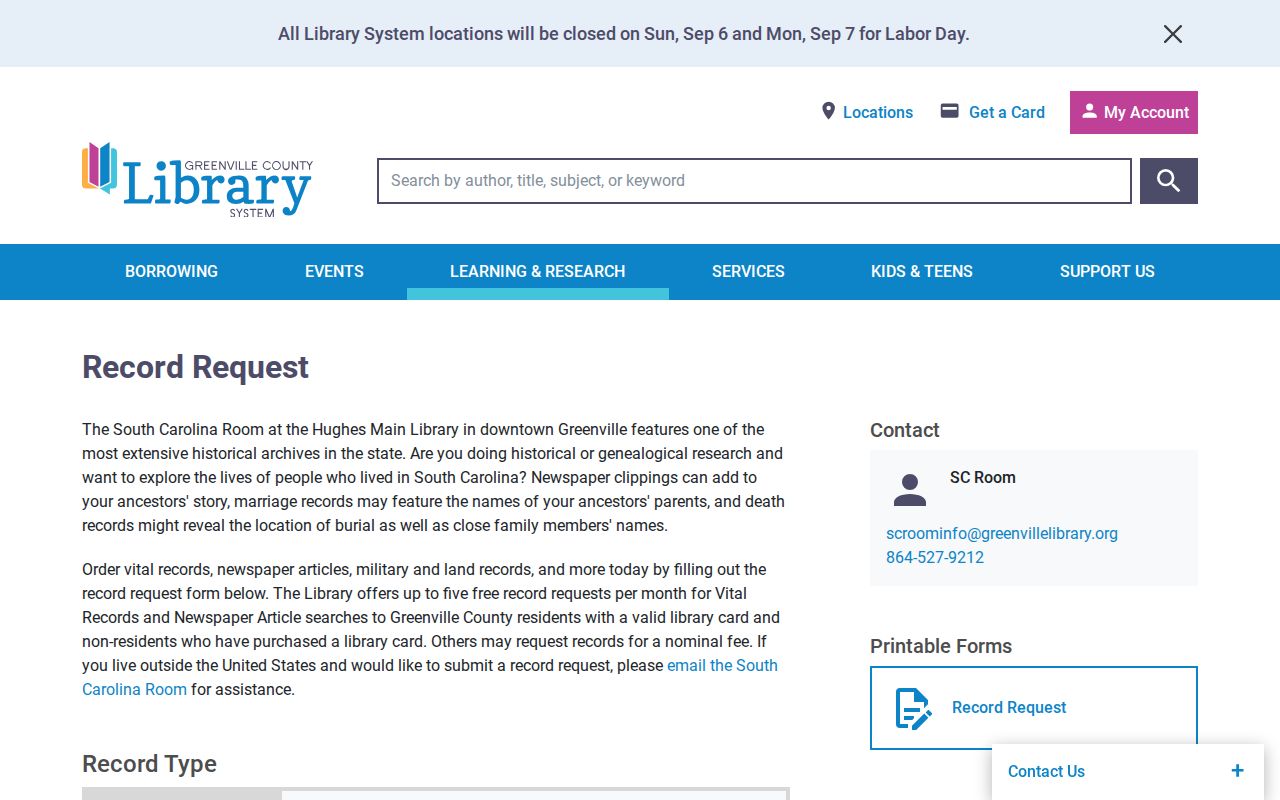
The request route gives a practical fallback for a defined historical question. It should not be used as a request for an open-ended search for people.
Note: Record-request fees, card allowances, and processing details are set by the library’s current service information and should be checked before submitting a request.
Greenville City Directory Sources Online
The digitized 1921–22 Greenville, S.C. City and Suburban Directory, volume XII, has page-image and OCR access. It includes alphabetical listings, business classification, a street guide, an index, and an abbreviation list. That makes it a strong way to learn the layout of a Greenville city directory before visiting a later volume. It is still a historical publisher’s index. It is not a certified record, an ownership record, or a continuous address series.
Browse Digitize Greenville for the library’s searchable collections and their item-level metadata.
Digitize Greenville is broader than directories. Its named collections include historic maps, cemeteries, residences, Greenville High School yearbooks, community material, and Greenville County deed books, which can help test a dated directory clue.
The digital service supports a basic search plus collection filters and advanced fields such as title, subject, description, creator, date, type, format, and coverage. Date entries accept year, year-month, or full-date formats. Metadata differs by collection, so search results describe an item rather than guarantee the contents of every page within it.
Searching Greenville City Directory Metadata
Digitize Greenville is a discovery layer for directory-adjacent material as well as scanned volumes. Use a basic term for a surname, street, institution, or subject, then narrow the result only when the collection and date fit the question. Its advanced search fields describe the digitized item. They do not turn every metadata hit into proof that a person lived at a Greenville address.
| Search term | Optional basic text search across the service. |
|---|---|
| Collection filter | Optional selector that can limit a search to one or more named Greenville collections. |
| Advanced field | Optional field choices include title, subject, description, creator, publisher, contributor, date, type, format, identifier, coverage, rights, and configured local fields. |
| Date range | Optional date controls accept year, year-month, or full-date entries. The end date cannot precede the start date. |
| Sort | Results can use relevance or title with ascending or descending settings. |
Record the collection name, title, item date, and identifier when an item supports a directory lead. The Greenville County Deed Books collection, for example, can expose fields such as title, creator, date, subject, description, county, rights, identifier, media type, and transcript or full text where available. That is an item-description schema, not a claim that every deed-book page carries every field.
Note: Preserve the collection name and item date, because a digital search result can describe material from many different Greenville eras.
Reading a Greenville City Directory Entry
Start with the abbreviation page in the exact volume. In the 1921–22 edition, h means home or residence, bds means boards, rms means rooms, and (r) means rear. An alphabetical entry may give a name or initials, spouse notation, occupation or organization, a residence or boarding label, and an address with directional or street-type abbreviations. Copy the words as printed and keep the page reference with the transcription.
| Name or initials | The person name as the publisher indexed it, including initials and spelling. |
|---|---|
| Spouse notation | A relationship clue when the entry includes one, not proof of an entire household. |
| Occupation or organization | A dated clue that can distinguish people with the same name. |
| Residence mark | Terms such as h, bds, rms, or (r) as defined in that edition. |
| Street address | A publisher’s address listing for that edition, useful to compare with other dated sources. |
- Criss-cross directory
- An address-to-name or street-order reference volume when one is actually available for the year. It is compiled evidence, not title evidence.
- Householder index
- An index organized around the named household contact. It can leave out other people at the address.
- Abbreviation key
- The volume’s own explanation of shortened terms. Photograph or transcribe it before interpreting a listing.
Greenville Directory Context at the Historical Society
The Greenville County Historical Society resources place directory research beside maps from the 1880s, Sanborn maps, McBee documents, deeds, plats, and more than 5,000 photographs. The Society’s directory holdings begin in 1883, which makes it a distinct source for an era before the documented library directory years. Its McBee material covers 1786–1934 and includes land grants, deeds, plats, business records, and an 1815 land deed. These are local-history collections, not a complete county-wide name index.
Search the Greenville Library archival catalogue when the question points beyond a printed volume to manuscripts, photographs, ledgers, or another archival collection.
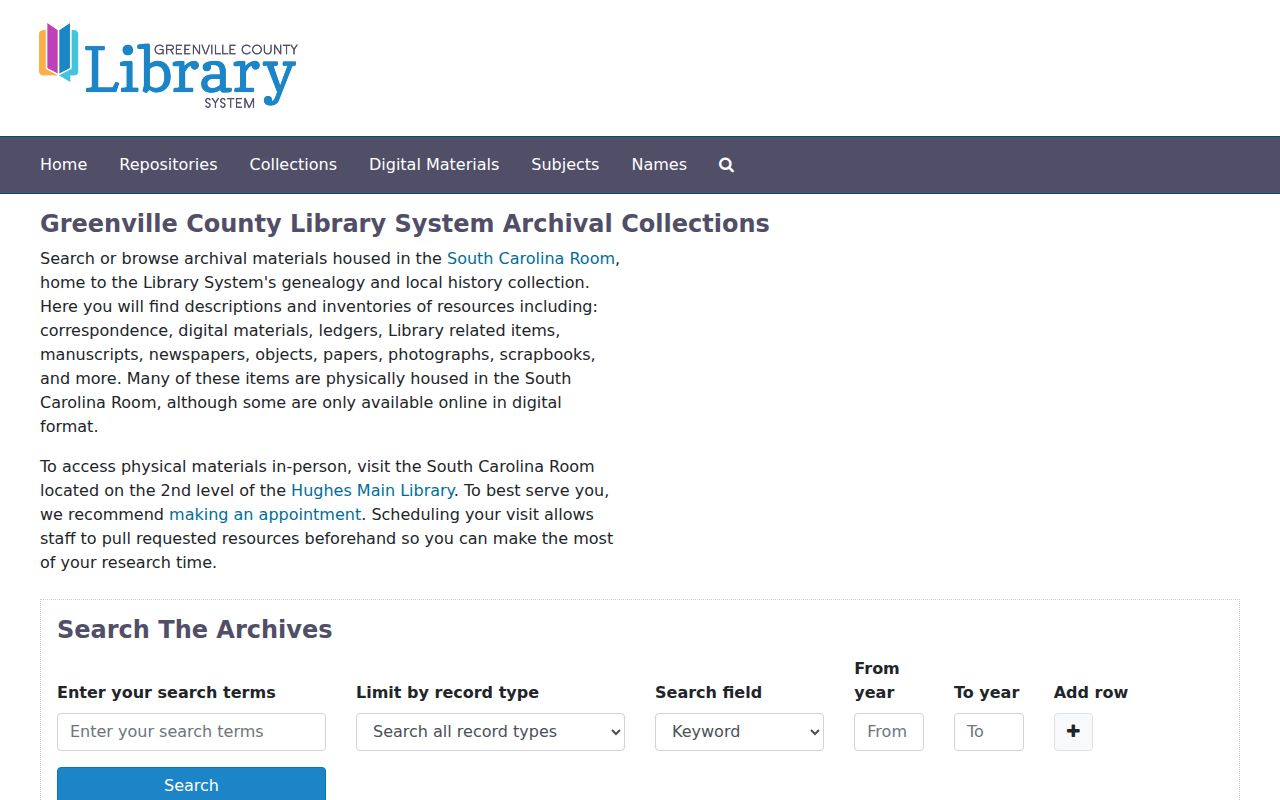
The archival interface searches terms and can limit results to all records, collections, or digital materials. Physical access is generally through the South Carolina Room, while some material is online.
Tracing Greenville City Directories Through Families
A Greenville city directory is most useful when it is paired with records that answer a different date and question. Follow a name through confirmed editions, then compare a near-by federal census, a deed or tax-parcel record, and a newspaper notice. A directory captures a publisher’s compiled listing around its publication cycle. A census is a household snapshot on its enumeration date. A deed records a property transfer. Keeping those roles separate avoids turning one address line into a claim about ownership or continuous residence.
- Find the earliest verified Greenville directory entry for the name, and transcribe the initials, address, notation, and page.
- Check one or two confirmed editions on either side, noting moves, spelling changes, and a changed occupation or spouse notation.
- Use a reverse or street-order volume only if the library or archive lists that type for the relevant year.
- Pair the closest available directory edition with a released federal census, which becomes public after 72 years.
- Test a death, family, or estate clue in the obituary index, probate material, and recorded documents where the dates fit.
A disappearance can mean a move, a death, an omitted listing, or a missing directory year. The Greenville News obituary index covers 1901 to the present, with linked request service and South Carolina Room microfilm. Search its alternate-name, location, age, and war filters before treating the first surname result as the right person.
Note: A cemetery or obituary result can document a death or burial clue, but neither one establishes a person’s ordinary residence at a particular address.
Greenville City Directories Are Not All Online
Greenville’s historical resources correct a common assumption that every local record is available through one web search. The County Historical Records program describes high-resolution deeds, probate estate papers, and District Court material, but also says digitization is incomplete because of the volume and cost of the work. Its catalogue names conveyance, probate, judgment, jail, sale, and writ collections alongside other county books. Some material remains on microfilm, microfiche, or with the originating office.
For a directory question, start with the catalogue or digitized item, then use a South Carolina Room appointment, a focused request, or the historical society’s physical-repository access. For records outside a directory, identify the actual custodian instead of assuming a library image is the official version. That sequence preserves both the useful historical lead and the limit of the source.