
Greenville Resident Lookup Coverage
Official Greenville sources answer different questions. The Greenville County Real Property Search can identify the owner or tax contact attached to a selected-year parcel. County Maps provides parcel and road context. The Register of Deeds Official Records Search can show a party in a recorded document. A court index can identify a nonsealed case, while an obituary or vital route may establish a historical event. Each is a lead, not a broad profile of a person.
| Record | What It Confirms | Where | Access |
|---|---|---|---|
| Property tax parcel | Selected-year owner or tax-contact lead | Greenville County Real Property Search | Free page; county counter can verify |
| Recorded document | A named grantor, grantee, or party | Greenville County Register of Deeds | Free official search; copies and certification available |
| Court case | Case number, court, and status if public | Greenville or South Carolina Public Index | Index first, then a targeted Clerk request |
| Death or event lead | Historical death notice or event information | Library obituary index and state routes | Online, microfilm, request, or statutory copy path |
| Probate estate | Case-specific representative or heir information | Greenville County Probate Court | Search lead; files remain with the office |
Use the record that fits the question already known. A parcel or street address points to property tools. A case number belongs with the Clerk. A known death date belongs with the library and state record channels. The county GIS map can connect a parcel to its map number, but it does not identify everyone who lives there.
Greenville Resident Name Matches
A matching name needs an anchor. Compare a middle initial, a time period, party role, map number, legal description, case number, or document number before joining records. The County property form accepts one nonempty criterion at a time, with Name, Street, Map No., Subdivision, Sales Sheet No., and tax-year choices. It is useful for a specific parcel lead, not a directory of every person at an address. A situs address is the property location, while a mailing address is where tax notices go. Those fields can differ.
The same distinction applies to land records. A grantor or grantee is a party to a recorded transaction, which does not establish present residence. The county Maps application can display parcel context, adjacent parcels, reports, and historical aerial comparisons. It can help confirm that the parcel number and address line up before a name is carried to the deeds index.
Match carefully. A tax owner, a mailing contact, a recorded-document party, and a resident are different claims. Use each record only for the fact it actually supports.
Note: Greenville's GIS transition warns that some physical-property details may not be current, so cross-check important details with the relevant custodian.
Greenville Court Index Records
The Greenville County Public Index is an entry point for county court searching, while the South Carolina Judicial Branch case-search directory routes users to court systems that may have different forms and coverage. The official guide documents searches by case number, party or business name with a Contains option, action type, date type and range, tax map number, court type, court agency, case type, subtype, and party type. One or two criteria are recommended because all supplied criteria must match.
A result is a prompt to verify identity, not an answer about where someone lives. The guide says a case screen may show its number, court agency, filed date, case type, file type, status, assigned judge, disposition, party rows, and action history. Document and image access varies. Juvenile, adoption, sealed, expunged, and other confidential material may be unavailable. Since January 2026, the Judicial Branch reports restrictions on Public Index home-address display for existing and new cases.
| Possible case-page item | How it helps identify the right record |
|---|---|
| Case number and court agency | Gives the Clerk a precise file to locate. |
| Filed date and case type | Separates people with the same name and different matters. |
| Party role and status | Shows the person's relationship to the case, if displayed. |
| Disposition or action history | Supplies dated case context, not a residence finding. |
| Document or redaction indicator | Signals that copy access or confidential treatment may apply. |
Greenville Vital and Probate Records
For a death or family-history lead, the Greenville Library obituary index covers Greenville News notices from 1901 to the present and connects researchers to microfilm and requests. The library describes a state death-index lead for 1915 through 1974. Neither source replaces a state certificate. South Carolina death records become public after 50 years under S.C. Code Ann. § 44-63-84; before that, access depends on the statutory relationship or direct-interest rules. A person who cannot receive a certificate may sometimes receive an event statement under the governing rules.
For a certificate or statement, use the current South Carolina Department of Public Health form and the agency's live instructions for identity, payment, mailing, and processing. The regional DPH Vital Records office is at 352 Halton Road in Greenville, while the state also has a mail route. Marriage and divorce in-person or drop-off processing was reported temporarily unavailable from June 19, 2025, so confirm the current operational status before a visit. The South Carolina Room, state archives, and the library request service remain useful historical fallbacks, but they do not issue state certificates.
The Greenville County Marriage License Search is a local discovery route with its own online-listing opt-out, but certificate and copy rules remain separate. Greenville Probate has its own case search for Name, Case Number, and Party Type. Estate files are available at the Probate office rather than as a promise of a full remote file set. An heir question should start with a known decedent and a particular estate, then use the office's case-specific process.
The county marriage-license search provides a local online listing that can point a researcher toward the appropriate event and custodian.
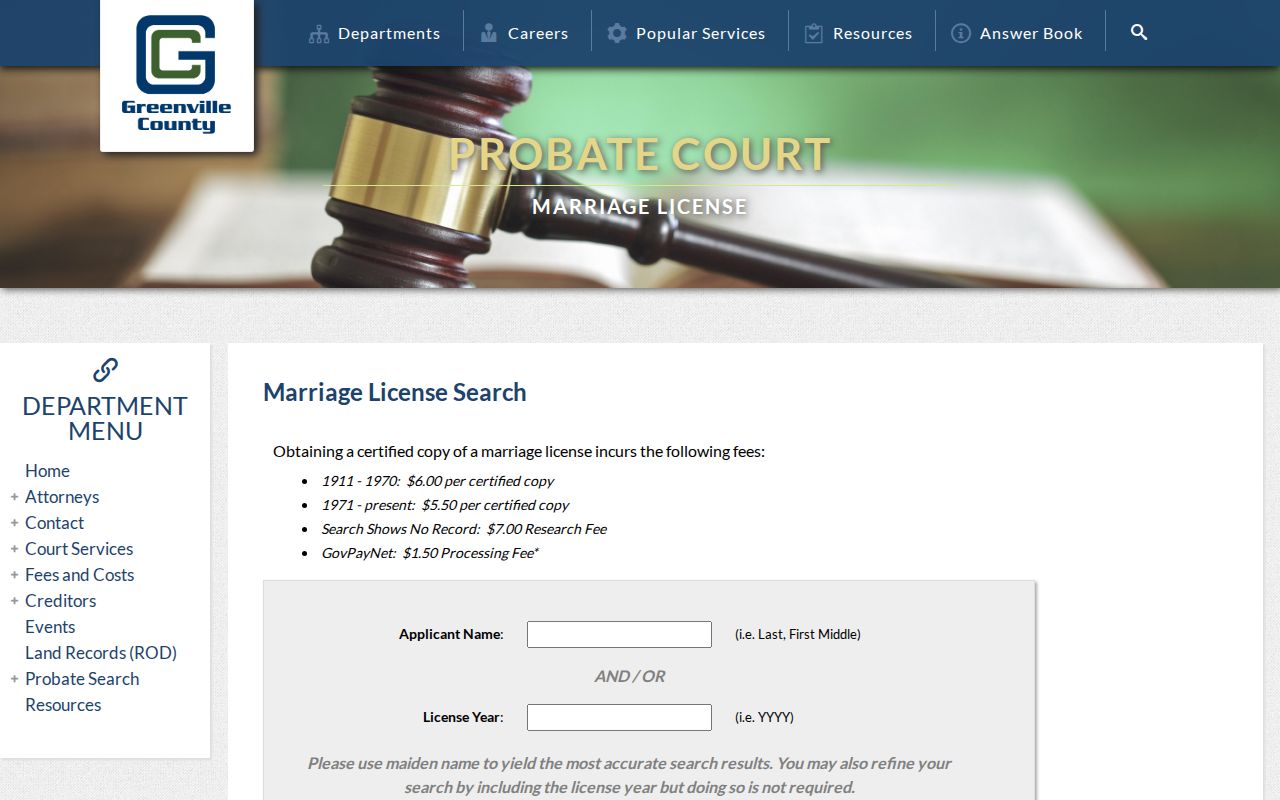
The screen is a discovery surface, not a substitute for the official certificate or a confidential court file.
The Greenville Probate case-search page offers a narrow path for a named estate or case number.
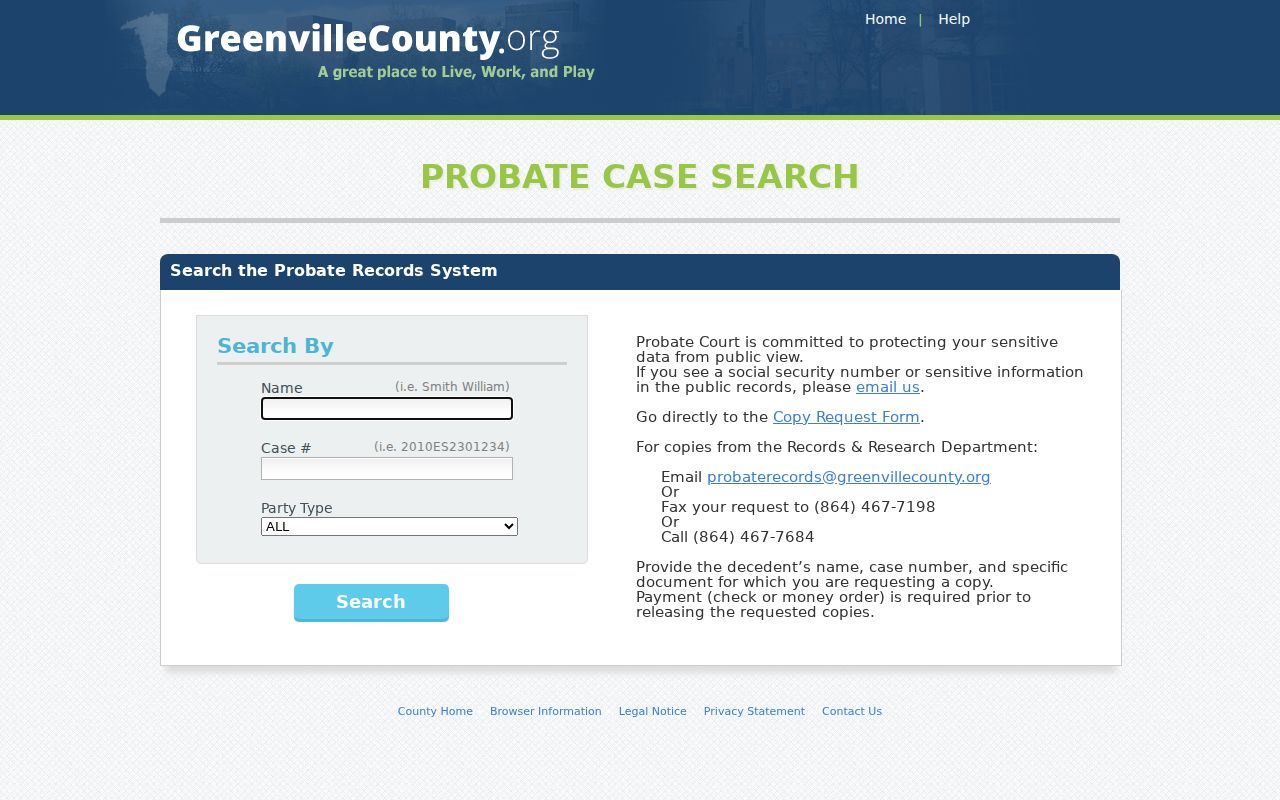
Use a case number and party type to ask the Probate office for the particular file or copy route.
Note: A marriage or probate search result identifies a record lead, not a current address for any listed person.
Verify a Greenville Resident
Verification works by moving from a narrow fact to the next official record. Begin with a name spelling and a rough date. If a property record is relevant, record its tax year and map number. If the question concerns a court matter, use the party result only to obtain the case number, then ask the correct office for a copy. For an older death or household trail, pair an obituary lead with Probate, a state route, or a dated historical collection. This approach reduces false matches without turning separate records into a single profile.
Greenville County tools work best in sequence. Keep the exact spelling used by Greenville Property Search, Greenville County Maps, the Greenville Register of Deeds, and the Greenville Clerk with the date and identifier from each result. A later check can then test whether the records actually refer to the same Greenville person or only to a similar name.
- Search the Greenville property form by the one known criterion, then write down the selected tax year and map number.
- Use County Maps to check that the parcel, site address, and geography match the record being compared.
- Search the Register of Deeds or Public Index with the matching name and a document or case clue, not the name alone.
- Request a copy from the ROD, Clerk, Probate Court, or state agency only after identifying the specific record needed.
- Docket
- A dated list of actions in a court case. It helps locate a file but is not a finding about residence.
- Index and image
- An index lists record clues such as names or numbers. An image is the underlying document and may have separate access or redaction rules.
- Certified copy
- A custodian-issued copy with formal certification. It is different from an online index entry or a library discovery result.
Greenville Court Copy Routes
The Clerk's Copies of Records channel is the next step after a court index identifies a case. The Clerk says most Common Pleas civil images can be printed online, while General Sessions commonly provides case or file information rather than every image. Standard copies are listed at $0.25 per page and certified or sealed documents at $10. Unfiled electronic records may be viewed at 305 E. North Street, second floor, and legacy material can take time to retrieve.
Family records have a location and time split. The Clerk notes that files from 1925 through April 1996 are with the Circuit Clerk, with later files at Family Court. Call before visiting because access and location details can change. The Greenville courthouses are open on weekdays from 8:30 a.m. to 5:00 p.m., excluding county holidays. For a federal case, PACER and the federal Clerk are separate channels with their own registration, fees, and sealed-document limits.
The Greenville Clerk copy page shows the county's record-copy pathway for an identified case.
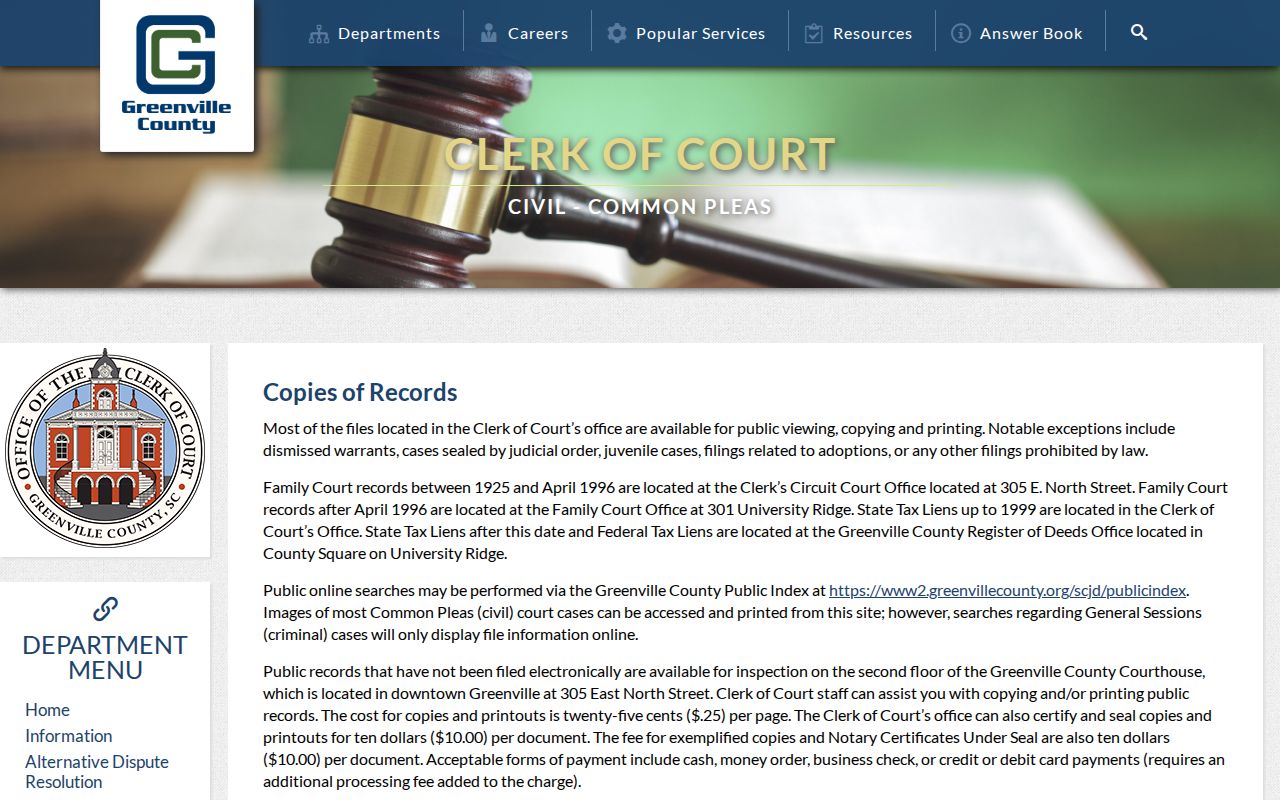
When online court documents are unavailable, give the Clerk the case number, court division, requested document, and certification need.
Note: The Judicial Branch reported Greenville document-retrieval problems after 2026 e-filing updates, so a counter or copy request may be necessary.
Greenville Affiliation Record Limits
State entity and credential searches can confirm a narrow affiliation or status, but they do not establish a home. The South Carolina Business Entities Online form accepts a business name and offers Begins With, Contains, and Exact Match choices. The state says a selected result opens the official business profile and relevant information, but research did not verify a standard profile-field set. A registered office, agent, filing officer, or business address should not be treated as a private residence.
The South Carolina LLR Licensee Lookup begins with a required board selector. Board-specific forms load only after a selection, so the live result controls what may be confirmed. Use it to verify the credential status actually displayed, not to create a personal location record. The same caution applies to any filing address retained by a state agency.
The South Carolina entity-search form is useful when a precise entity name is already known.
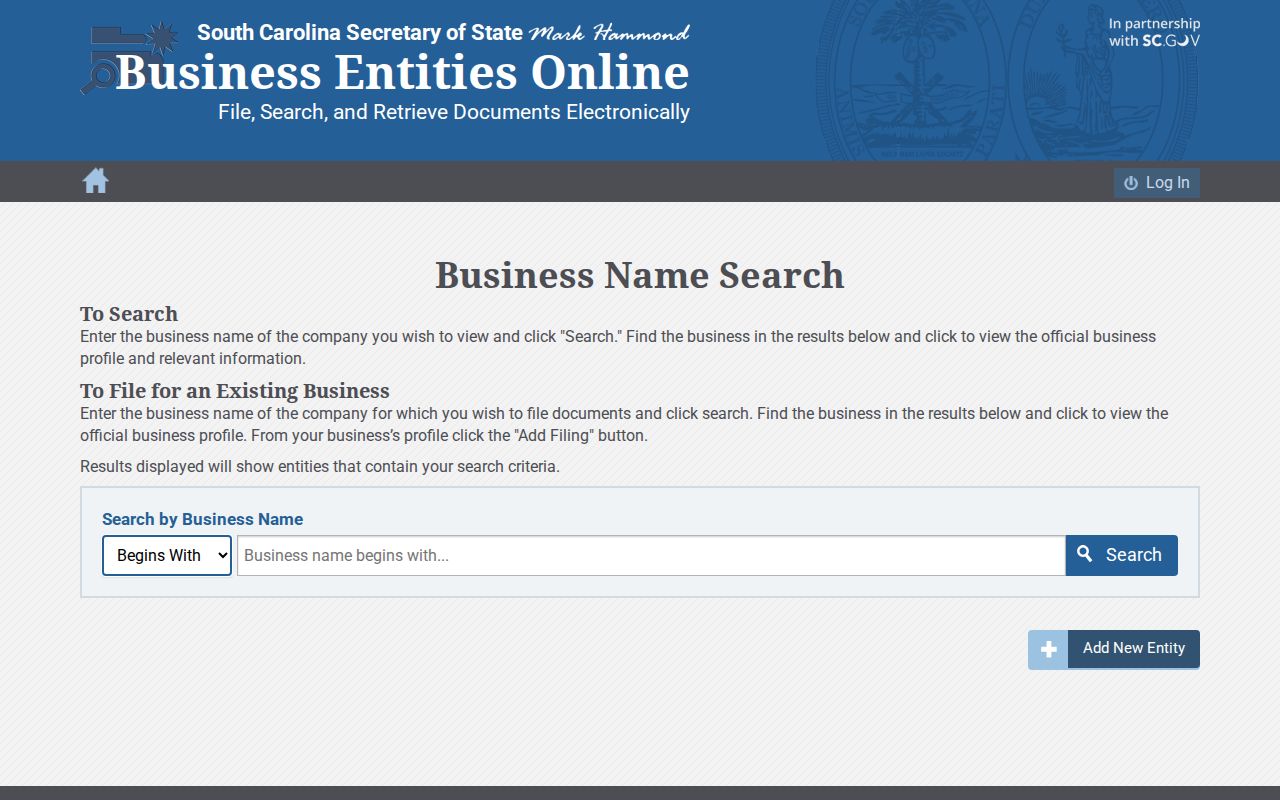
Its search controls establish an entity lead and should be reconciled with the record's date and identifier.
The South Carolina credential lookup requires a board choice before its available form controls appear.
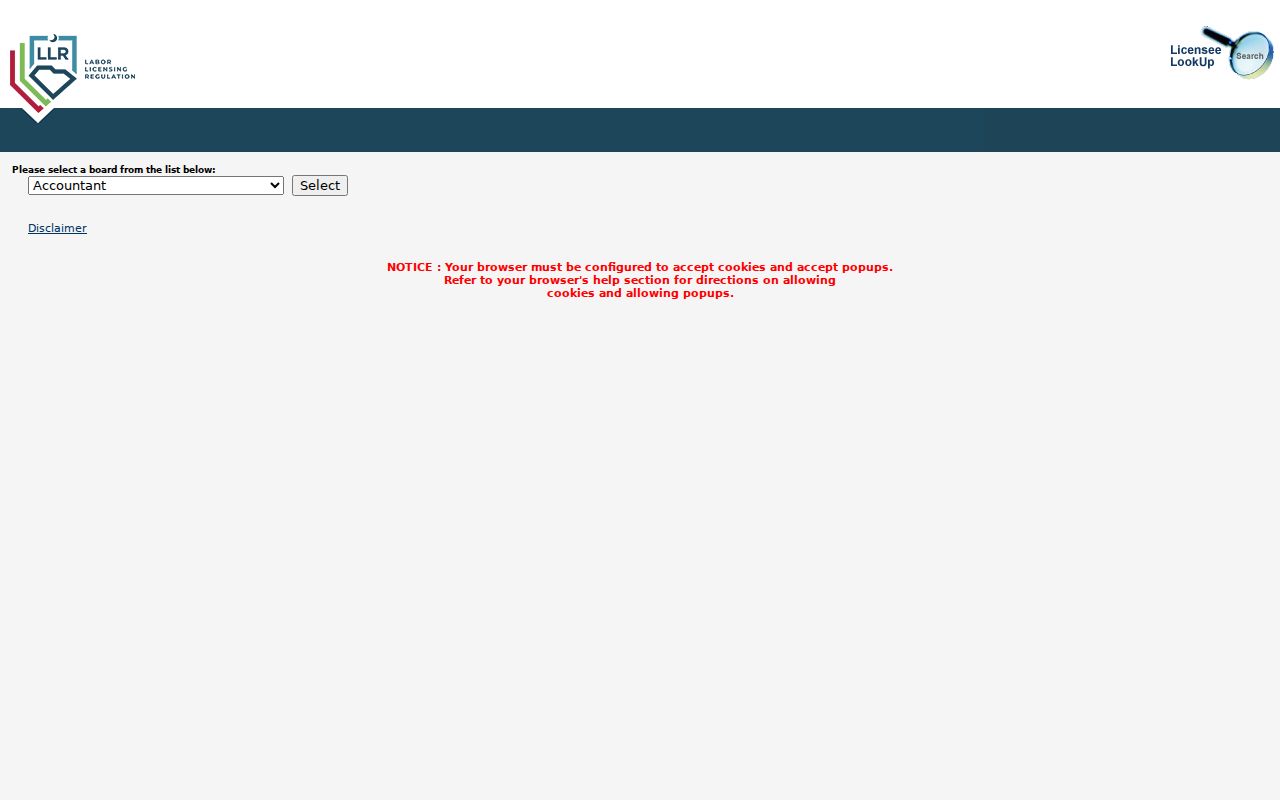
A displayed credential is limited to the status and identifying information shown by that official board route.
Greenville Resident Lookup Limits
South Carolina's Freedom of Information Act provides access to nonexempt records under S.C. Code Ann. §§ 30-4-10 through -165, including the response, fee, and production rules in § 30-4-30. That law does not override vital-record confidentiality, sealed court material, protected voter data, adoption records, library-user records, or protected addresses. MySCVotes is a secure voter-facing tool for a voter to check that person's own registration, precinct, polling place, and voting history. It is not an open name-and-address roster.
For a permitted voter-record question, Greenville County Registration and Elections can explain the current request form, fees, available fields, delivery options, and restricted uses at 864-467-7250. A narrow request may be made through the proper county or state channel, but a records request cannot override election-code confidentiality. For an older precinct or poll-book question, ask the county election office, South Carolina Room, or state archives what dated material is actually held.
The South Carolina Attorney General's Address Confidentiality Program gives eligible participants a substitute address for agency and court use. It does not erase every existing record, and a separate request may be needed at each custodian. Qualifying current or former judges and certified law-enforcement personnel have web-address, cell-number, and tax-map protections under the state privacy guidance. Motor-vehicle, utility, and delivery customer information are not household-lookup sources.
Lawful use. Use Greenville records for family history, estate matters, property history, civic transparency, or correcting a record. Using information to stalk, harass, intimidate, or harm anyone is prohibited.
Greenville Record Correction Routes
When an official entry is wrong, go to the office that created it. Greenville property facts belong with the tax or property office. A qualifying identity-information redaction request for an internet image belongs with the Register of Deeds or Clerk. Election updates belong with Elections, vital amendments with the Department of Public Health, and court correction or sealing questions with the court. The ROD describes a no-fee written request for certain exposed identifiers on an internet image; it does not remove the original official record.
For a record that is unavailable online, use the Greenville County FOIA portal or the specific custodian's counter, form, phone, mail, library, or archive route. Name the record category, case number, parcel, date, and document sought. The South Carolina Room can handle historical material through its request service, while state archives and local repositories may hold older records absent from a current portal. A precise request gives the custodian a record to locate rather than asking for an open-ended people search.
Note: A correction, redaction, or access request follows the controlling custodian's procedure and does not create a new public record.